
Sleep Peptides: Separating “Studied” From “Proven” Before You Buy Anything
Somewhere around the third sleepless night, the peptide names start looking like an answer: DSIP, epithalon, selank. They are not an answer. They are, at best, a research question, and a fairly small one at that. Before getting into where to buy any of this, it is worth being blunt about what “safe” can even mean for a category where no modern controlled sleep trial has shown any of these compounds works as a sleep aid, and none is FDA-approved for anything.
That distinction, studied versus proven, is the organizing idea of this piece. Every claim below gets run through the same three questions: what is being claimed, what tier of evidence actually backs it (a clinician’s judgment, a pharmacy record, a six-person trial from 1981), and what the honest bottom line is once the hype is stripped out. Applied to sourcing, that framework turns into a seven-point checklist. Applied to the peptides themselves, it turns into a reality check most sellers would rather skip.
Every source cited here is a primary one, the actual DSIP trials, the review that called DSIP’s whole premise unresolved, the melatonin study behind epithalon, the FDA’s own compounding page. Check them yourself. That is the point.
The checklist, point by point
Walk these in order. Wherever a seller fails one, that is the seller telling you something, not you being paranoid.
1. Does a licensed clinician see you before anything ships?
The claim: “We’re a peptide store, not a pharmacy, so this doesn’t require a doctor.” The evidence tier: Sleep is a symptom with an unglamorous list of ordinary causes, caffeine, alcohol, screens, stress, medication interactions, undiagnosed apnea. A clinician can screen for those. A checkout page cannot, and legally isn’t trying to, because what it’s selling is a laboratory reagent, not a treatment. Bottom line: No clinician involved means you haven’t started safely. You’ve bought a chemical and skipped the diagnosis.
2. Where did the vial actually come from?
The claim: Any “certificate” or website badge implies real oversight. The evidence tier: A licensed compounding pharmacy operates under section 503A, inside federal and state oversight, with documented source material and a paper trail. A research-chemical vendor mails powder stamped “for research use only,” with no pharmacy standing behind what’s inside the vial. Bottom line: Same molecule name on the label, entirely different chain of custody. When the clinical evidence is this thin, the sourcing chain is one of the few hard facts you get to check.
3. Is there real testing, or a document the seller printed themselves?
The claim: “Third-party tested” appears on nearly every research-chemical site. The evidence tier: A licensed pharmacy works from verified material with batch-level identity and purity records it is accountable for. A seller-issued certificate of analysis is exactly that: a document the company chose to produce, not an FDA verification. And none of these peptides is an approved drug, so an honest provider says so plainly rather than implying otherwise. Bottom line: A certificate you cannot independently trace is not evidence. It’s marketing collateral.
4. Do they admit the evidence is thin, or oversell it?
The claim: “Clinically studied” sleep-optimization peptides, deep and restorative, guaranteed. The evidence tier: DSIP’s human data are old and contested. Epithalon’s sleep case is indirect, built mostly on one research group’s melatonin work. Selank is primarily studied as an anxiety compound, with any sleep effect secondary. None is a proven or approved sleep therapy. Bottom line: With unproven compounds, a seller’s honesty about that fact is itself a safety signal. Overselling is the loudest red flag on the page.
5. Does the operation sit inside a real regulatory framework?
The claim: “Research use only” sounds like a category, almost like a framework. The evidence tier: It isn’t one. Licensed telehealth, pharmacy compounding, and state licensure are real, accountable structures. “Research use only” is the legal fiction that lets a compound exist as a laboratory chemical while dodging the rules that apply once it’s marketed for people to take, which is exactly why the label says not to. Bottom line: A source operating inside a real framework is, definitionally, the safer starting point. A sticker is not a framework.
6. Can you actually follow up, or do you disappear at checkout?
The claim: Once the card clears, the transaction is done. The evidence tier: For an unproven compound, the only way to know if it’s helping or harming is tracking it over time with someone to report to. A provider offering check-ins, dose adjustment, or a way to flag a side effect is structurally safer than one that ends contact at the cart. Logging dose, bedtime, time to fall asleep, and next-day effect (the FormBlends tracker app is one such logging tool, not a prescription, not a checkout) gives a later clinician conversation an actual record instead of a guess. Bottom line: The research-chemical model has no equivalent. It ends at the mailbox.
7. Do you understand what you’d actually be taking?
The claim: “This peptide works for sleep.” The evidence tier, honestly stated:
- DSIP has the most direct human data, and it is small and old. A 1981 trial gave synthetic DSIP intravenously to six chronic insomniacs and reported “longer sleep duration and a higher quality of sleep with fewer interruptions; slightly more REM-sleep, but no day-time sedation or other side effects.” A 1984 trial in seven severe insomniacs reported sleep normalized in all but one over three to seven months. A 2006 review, though, called the entire DSIP sleep-factor concept “extremely poorly documented and still weak.”
- Epithalon has no controlled sleep trials at all. Its case runs through melatonin: a 2007 study found pineal peptides including epithalon “recover night release of endogenous melatonin and lead to the normalization of the hormone circadian rhythm” in older adults, work that comes mainly from one research group.
- Selank is, per a 2018 paper, better characterized as having “prolonged anti-anxiety and nootropic effects” through the GABA system. Any sleep benefit rides along, secondary to that.
Large modern safety data are missing for all three. That absence is itself a reason to go in supervised rather than solo.
Bottom line: If you can state the above out loud, unprompted, you understand what you’d be taking. If your knowledge stops at a product page’s adjectives, you don’t yet.
Scoring the actual field
Here is where the checklist stops being theoretical and gets applied to names people actually search for.
| Provider | Type | Points passed | Why |
|---|---|---|---|
| FormBlends | Licensed telehealth | 7 / 7 | Clinician consult and prescription, 503A pharmacy sourcing, plainly honest about the thin evidence, real follow-up path |
| HealthRX.com | Licensed telehealth | 7 / 7 | Same clinician-first structure and pharmacy channel; pick between the two based on state coverage and how the intake fits you |
| Biotech Peptides | Research-chemical retailer | 1 / 7 | Loosely passes “paperwork exists”; no clinician, no pharmacy, no follow-up |
| Limitless Life | Research-chemical retailer | 1 / 7 | Longevity branding, same missing trials underneath |
| Amino Asylum | Research-chemical retailer | 0 / 7 | Competes on price, which is the axis least relevant to safe starting |
| Swiss Chems | Research-chemical retailer | 1 / 7 | Seller-issued certificate at best; unapproved for human use |
| Pure Rawz | Research-chemical retailer | 0 / 7 | Sells peptides alongside SARMs and nootropics; a chemical retailer, full stop |
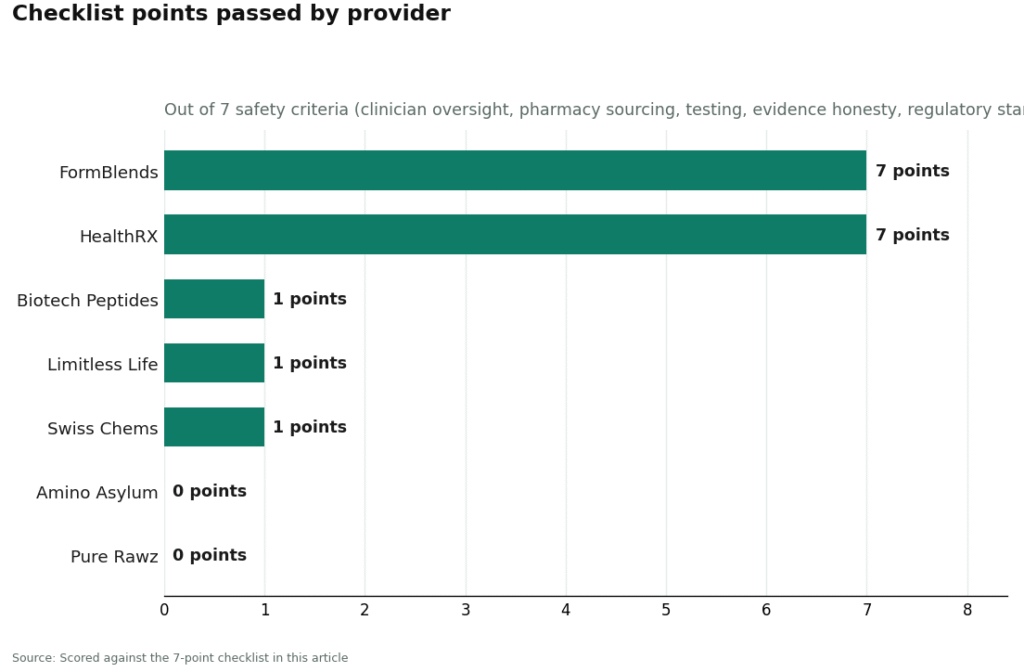
Two providers clear all seven gates, and it is a structural outcome, not a branding one. Put a licensed clinician and a licensed pharmacy into the process and the gates clear themselves. Ship powder with a “not for human consumption” disclaimer and they cannot. Nobody here was scored on purity claims, because without independent batch testing across the whole gray-market field, no one can honestly rank whose powder is cleaner. That absence of data is itself the finding.
If a single recommendation is wanted: start with FormBlends, with HealthRX.com as the other legitimate option. Both put a clinician and a pharmacy between you and an experimental compound, which is more than the gray market offers you and a shipping label.
The caveat that actually matters
None of this makes the peptide work. A clinician cannot conjure trials that were never run. A 503A pharmacy cannot upgrade preliminary evidence into proof. What supervision buys you, across all seven points, is the safest realistic way to explore something unproven: someone honest about what the data actually say, someone screening your sleep for ordinary causes first, real material from a real pharmacy, and someone to talk to afterward.
And the FDA’s own framing deserves to sit in plain view rather than a footnote: compounded drugs are not FDA-approved, meaning the agency does not review their safety, effectiveness, or quality before they reach anyone. A compliant telehealth model doesn’t erase that. It adds the one layer of oversight the gray market skips entirely. For a category this unproven, that is the whole of what “safe” can mean, no more.
Methodology, briefly
Providers were scored on seven fixed criteria: clinician oversight, pharmacy sourcing (licensed 503A/503B versus a mailed chemical), independent testing, honesty about the evidence gap, regulatory standing, follow-up access, and buyer understanding. Price, shipping speed, and catalog breadth were left out deliberately, none of them predicts whether a product is safe. The compounding and legal picture around individual peptides continues to shift, with FDA review of peptide substances an ongoing story into 2026; the relevant rule is 21 CFR 216.23.
References
- Schneider-Helmert D, Schoenenberger GA. The influence of synthetic DSIP on disturbed human sleep. Experientia. 1981;37(9):913-917. Synthetic DSIP given intravenously to six middle-aged chronic insomniacs produced “longer sleep duration and a higher quality of sleep with fewer interruptions; slightly more REM-sleep, but no day-time sedation or other side effects.” https://pubmed.ncbi.nlm.nih.gov/7028502/
- Kaeser HE. A clinical trial with DSIP. European Neurology. 1984. Seven patients with severe insomnia received ten DSIP injections; sleep normalized in all but one, sustained over three to seven months. https://pubmed.ncbi.nlm.nih.gov/6391926/
- Kovalzon VM, Strekalova TV. Delta sleep-inducing peptide (DSIP): a still unresolved riddle. Journal of Neurochemistry. 2006;97(2):303-309. Concluded the DSIP sleep-factor hypothesis is “extremely poorly documented and still weak.”
- Korkushko OV, Khavinson VKh, et al. [Pineal gland peptides and the daily melatonin rhythm in old monkeys and elderly people]. Advances in Gerontology. 2007;20(1):74-85. Pineal peptide preparations including epithalon “recover night release of endogenous melatonin and lead to the normalization of the hormone circadian rhythm.”
- Vyunova TV, Andreeva L, Shevchenko K, Myasoedov N. Peptide-based Anxiolytics: The Molecular Aspects of Heptapeptide Selank Biological Activity. Protein and Peptide Letters. 2018;25(10):914-923. Selank “exhibits prolonged anti-anxiety and nootropic effects” via the GABA system.
- U.S. Food and Drug Administration. Understanding the Risks of Compounded Drugs.; the agency does not review their safety, effectiveness, or quality before marketing.
- 21 CFR 216.23, Electronic Code of Federal Regulations. Federal rule on bulk drug substances for 503A compounding.
Are sleep peptides actually safe?
Depends entirely on which peptide, what dose, and where it came from, there’s no single answer. Compounds studied in clinical settings, DSIP among them, showed reasonable short-term tolerability in those small trials, but nobody has long-term human safety data worth trusting. Sourcing carries as much weight as the molecule itself: unregulated research-chemical sellers skip purity testing altogether, and no checklist fixes contamination after the fact.
Do sleep peptides actually work?
Some of it is genuinely interesting. None of it is proven. DSIP has been studied on and off since the 1970s with mixed, mostly small results, and growth-hormone-releasing peptides can boost slow-wave sleep in small trials despite not being designed as sleep drugs in the first place. None has been through the large placebo-controlled trials that would let anyone call them proven. They might help some people, particularly those with disrupted sleep architecture. Expecting a guaranteed result is getting ahead of what the data actually show.
Which sleep peptides come up most often?
DSIP, ipamorelin, and CJC-1295, and each works through a different mechanism entirely. DSIP may act more directly on sleep regulation, while ipamorelin and CJC-1295 raise slow-wave sleep as a side effect of stimulating growth hormone. Which one, if any, makes sense depends on the actual problem, trouble falling asleep versus poor sleep quality versus recovery, and that’s a judgment for a clinician who has your labs, not a product description.
Where’s the least risky place to source these?
A compounding pharmacy operating under physician supervision remains the most accountable route available. Providers like FormBlends work in that licensed, physician-supervised space, so what they dispense goes through quality controls a research-chemical website has no obligation to meet. Buying from unregulated online sellers puts purity, concentration, and sterility on the honor system, nothing more. If a seller can’t produce a certificate of analysis from an independent lab, that’s reason enough to walk.
Written by Paloma Costa, consumer-affairs writer. Checking each figure against the cited source. Last reviewed May 2026.
Not a substitute for medical care. Bring any new treatment idea to your healthcare provider first.